

If you are facing a federal stalking or harassment charge, one of the hardest parts is not knowing what a conviction could actually mean. Federal stalking and harassment sentencing is not uniform across the country, and where your case is heard can shape the outcome in ways that feel deeply unfair. Two people accused of nearly identical conduct can walk into courtrooms in different states and leave with very different sentences.
That uncertainty is exactly why our team looked closely at the numbers. Stalking is far more common than many people realize, affecting roughly 13.5 million Americans every year, and while it is illegal in all fifty states, it can also be prosecuted at the federal level where penalties tend to be more serious. To help people understand what they may be up against,Chaney Criminal Defense Lawyers reviewed a decade of federal sentencing data to see where offenders have historically faced the toughest penalties and how California compares.
If you have questions about your own situation, you do not have to sort through this alone. You can call Chaney Criminal Defense Lawyers at 818-330-5198 to speak with our team, or reach out through our online contact form to request a confidential consultation.
Which States Impose the Toughest Federal Stalking and Harassment Sentences: Where Does the Data Point?
Our analysis drew on data from the United States Sentencing Commission, or USSC, covering federal cases between 2016 and 2025. Out of 659,339 federal cases reported during that period, 2,268 involved stalking and harassment offenses. That focused sample gives a clear view of how sentences differ from one state to the next.
The gap between the toughest and most lenient states is striking. Arkansas ranks as the toughest state by a wide margin, with an average federal sentence of 56 months, more than a year longer than the next closest state. Nevada follows at 43 months, and Alaska averages 42 months. Idaho and Iowa round out the top five, each averaging 39 months.
At the other end, Wyoming records an average sentence of just nine months. That is a nearly four year gap between Arkansas and Wyoming, even though every one of these cases moves through the same federal legal system. The national average sits at 28 months, which places both extremes in perspective.
A few patterns stand out when you look at which states cluster near the top:
- Arkansas: leads the country with a 56-month average and the largest gap between its average and median
- Nevada and Alaska: follow at 43 and 42 months, placing the Mountain West and Alaska among the harshest jurisdictions
- Idaho and Iowa: tie at 39 months to complete the five toughest states
- Wyoming: sits at the bottom with a nine-month average, the lowest in the nation
These rankings show that geography plays a real role in federal sentencing, even for the same category of offense. Understanding where a case falls on this map is a useful starting point for anyone trying to gauge what may lie ahead.
Average Versus Median Sentences: Why Do the Two Numbers Tell Different Stories?
Averages alone can be misleading, so it helps to look at median sentences too. The USSC calculates averages using every qualifying sentence, counting probation as zero months and life sentences as 470 months. Because of that method, a small number of unusually long prison terms can pull a state's average sharply upward.
The median tells a different story because it reflects the typical case and is less affected by extreme outcomes. Nationally, the median federal stalking and harassment sentence is 21 months, well below the 28-month average. When the two numbers drift far apart, it usually signals that a handful of severe sentences are inflating the average.
Arkansas is a clear example. Its average is 56 months, but its median is just 28 months, which suggests that several lengthy or possibly life sentences pushed the average up. Nevada shows the same effect, with a 43-month average against an 18-month median. New Jersey highlights the disparity even more sharply, pairing a 38-month average with a median of only 16 months.
Some states show the opposite. Hawaii posts nearly identical figures, with both its average and median at 33 months, and Wyoming's average and median are similarly close. In fact, only four states, Wyoming, Mississippi, Washington, and Wisconsin, have a median sentence higher than their average. Consistent numbers like these suggest outcomes that stay closer to the middle rather than swinging toward extremes.
Federal Stalking and Harassment Sentencing in California: How Do the Four Districts Compare?
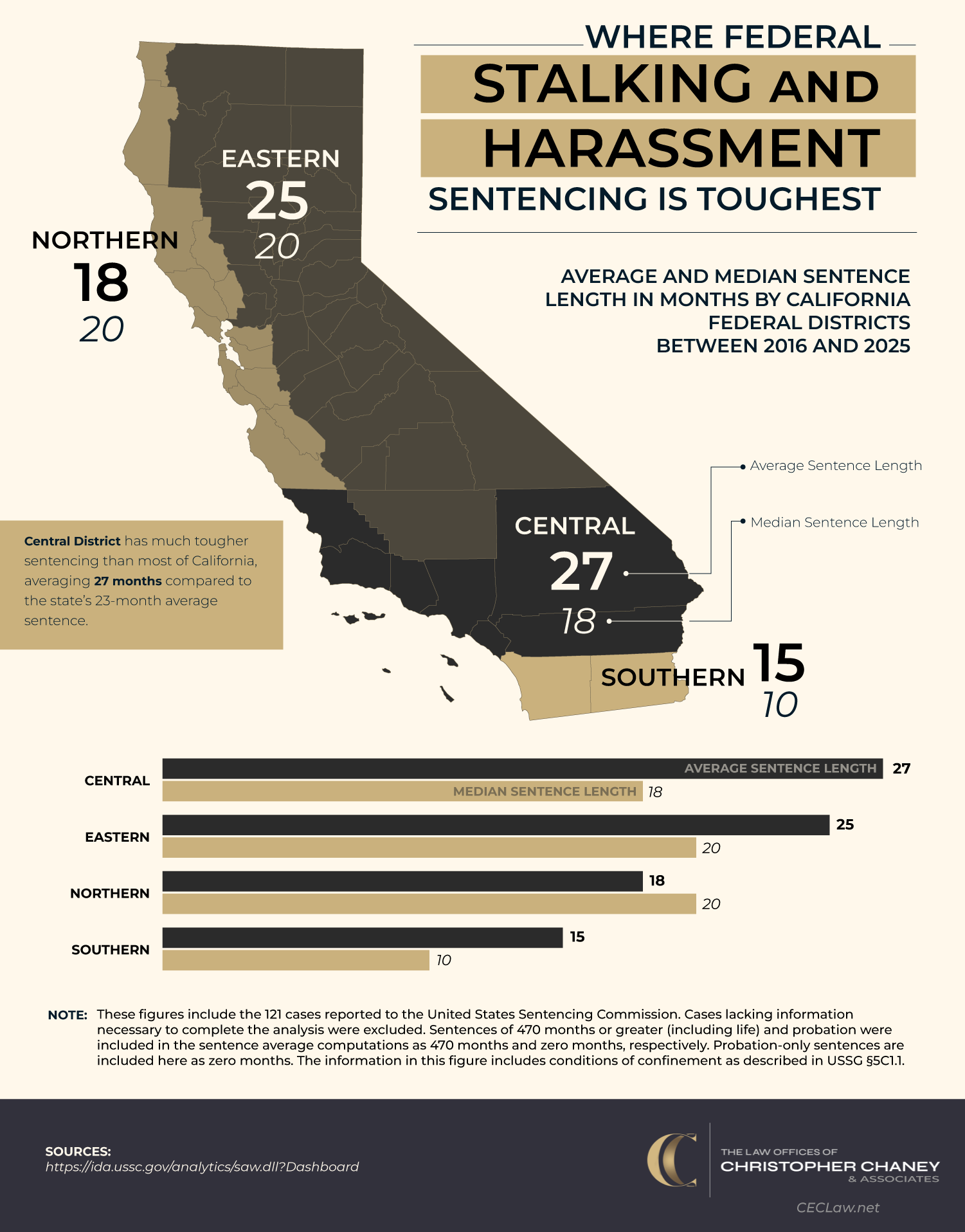
Overall, California ranks in the lower half of the country. With an average federal stalking and harassment sentence of 23 months, the state sits about five months below the national average, and its statewide median is 15 months. On the surface that looks moderate, but the picture changes once you look inside California's four federal districts.
The variation across those districts shows how inconsistent outcomes can be even within a single state:
- Central District: covers Los Angeles and records the state's highest average at 27 months, with a median of 18
- Eastern District: follows closely at a 25-month average and a 20-month median
- Northern District: averages 18 months with a median of 20
- Southern District: has the shortest average at 15 months and a median of 10
The difference between districts is less dramatic than the national spread, but it is still meaningful. An offender prosecuted in the Central District has historically received an average sentence a full year longer than someone prosecuted in the Southern District near San Diego. The Northern District, which includes the San Francisco Bay Area, is the only one in the state where the median sentence of 20 months exceeds its 18-month average, hinting that probationary sentences may be more common there than elsewhere.
What the Central District Findings Mean for Los Angeles: Why Does Location Matter for Your Case?
For anyone living in Los Angeles or the surrounding communities, these findings carry real weight. The Central District of California, which handles cases across the greater Los Angeles region, has historically imposed the longest average federal stalking and harassment sentences in the state. That pattern suggests local federal courts treat these cases as serious matters.
This does not mean an outcome is fixed before a case begins. Sentencing still depends on a combination of factors, including the governing federal law, a person's criminal history, and the specific facts presented to the court. What the data does show is that venue matters, and being charged in the Central District rather than the Southern or Northern District can influence the range a person realistically faces. Knowing that going in helps you and your defense team prepare rather than be caught off guard.
Practical Next Steps After a Federal Stalking or Harassment Charge: What Should You Do First?
If you are dealing with a federal stalking or harassment charge, the steps you take early can shape everything that follows. Federal cases move differently from state matters, and the stakes shown in this data make careful preparation important from day one.
A few practical priorities can help you stay grounded:
- Preserve information: keep messages, call logs, and any records that could clarify what actually happened
- Avoid contact: do not reach out to the accuser, since further communication can complicate a case
- Watch your statements: be mindful that anything you say to investigators can be used later
- Seek guidance early: talk with a criminal defense attorney before making decisions that are hard to undo
Taking these steps does not guarantee any particular result, but it puts you in a stronger position to respond thoughtfully. The sooner you understand the landscape, the more room you have to make sound choices.
Understanding the Law Behind the Numbers: How Are Federal Stalking Cases Prosecuted?
Federal stalking and harassment charges usually arise under the federal stalking statute, 18 U.S.C. section 2261A, which covers conduct that crosses state lines or uses interstate tools like phones and the internet to threaten or harass. California also prohibits stalking under Penal Code section 646.9, but this study focuses on cases prosecuted federally, where sentencing tends to be heavier. Because federal courts apply federal sentencing rules, the numbers in this analysis reflect that system rather than state court outcomes.
The USSC methodology also matters when reading these figures. The commission counts probation-only sentences as zero months and caps the longest sentences, including life terms, at 470 months for calculation purposes. The California district figures draw on 121 reported cases and include conditions of confinement as described in the sentencing guidelines. None of this predicts how a specific case will end, but it explains why averages and medians can differ and why location surfaces so clearly in the data.
Frequently Asked Questions About Federal Stalking and Harassment Sentencing
What Is the Average Federal Stalking and Harassment Sentence in California?
Across California, the average federal sentence is 23 months, roughly five months below the national average of 28 months. The statewide median is 15 months.
Which California Federal District Has the Toughest Sentencing?
The Central District, which includes Los Angeles, records the highest average at 27 months, a full year longer than the Southern District's 15-month average.
Why Are Average and Median Sentences So Different in Some States?
Averages include rare, very long sentences that pull the number upward, while medians reflect the more typical case. Large gaps, like Arkansas at a 56-month average and a 28-month median, point to a few severe outcomes.
Does Where I Am Charged Really Affect My Sentence?
The data suggests it can. Sentences vary widely by state and even by district within California, though individual factors and the facts of a case still play a central role in any outcome.
Talk With a Los Angeles Federal Defense Team About Your Case
The numbers in this study make one thing clear. Federal stalking and harassment sentencing can shift dramatically depending on where a case is heard, and in California, the Central District covering Los Angeles has historically been among the toughest. If you or someone you care about is facing these charges, understanding that landscape is the first step toward protecting your future.
You do not have to face the federal system alone. Call Chaney Criminal Defense Lawyers to talk through your situation, or reach out through our online contact form to request a confidential consultation and learn how our team can help guide you forward.
Disclaimer: This blog is intended for informational purposes only and does not establish an attorney-client relationship. It should not be considered as legal advice. For personalized legal assistance, please consult our team directly.