Stalking is far more common than many people realize, affecting roughly 13.5 million Americans every year. Although legal definitions can vary by region, stalking is illegal in all 50 states and can also be prosecuted under federal law.
Due to the potential impact on victims, sentencing for stalking can be severe, particularly when a case is tried at the federal level. While sentence lengths may vary from case to case, they are not uniform across the country. For the same offense, one person may receive a significantly harsher sentence than someone just across state lines.
To better understand these differences, Chaney Criminal Defense Lawyers collected federal sentencing data to identify where stalking and harassment offenders have historically received the toughest penalties and to see how California compares to the rest of the country.
Embed the national infographic on your site
<a href="https://www.ceclaw.net/research-studies/where-federal-stalking-and-harassment-sentencing-is-toughest/">
  <img src="https://cdn.sanity.io/images/m2us9422/production/8842fcd41b1b11c83e01a84dc3d67fea649e5db7-1501x2899.png" alt="Where Federal Stalking and Harassment Sentencing Is Toughest - Chaney Criminal Defense Lawyers LA Criminal Defense Attorneys - Infographic" title="Where Federal Stalking and Harassment Sentencing Is Toughest - CECLaw.net - Infographic" width="1501" height="2899" style="max-width:100%;height:auto;">
</a>
<br>
<a href="https://www.ceclaw.net" title="CECLaw.net">By CECLaw.net</a>
Which States Impose the Toughest Federal Sentences?
The sentencing in a stalking or harassment case is determined by a combination of factors, including federal law, a defendant’s criminal history, and the specific details presented to the court. However, our analysis of data from the United States Sentencing Commission (USSC) over the past decade has shown that where you live can also affect the length of your sentence.
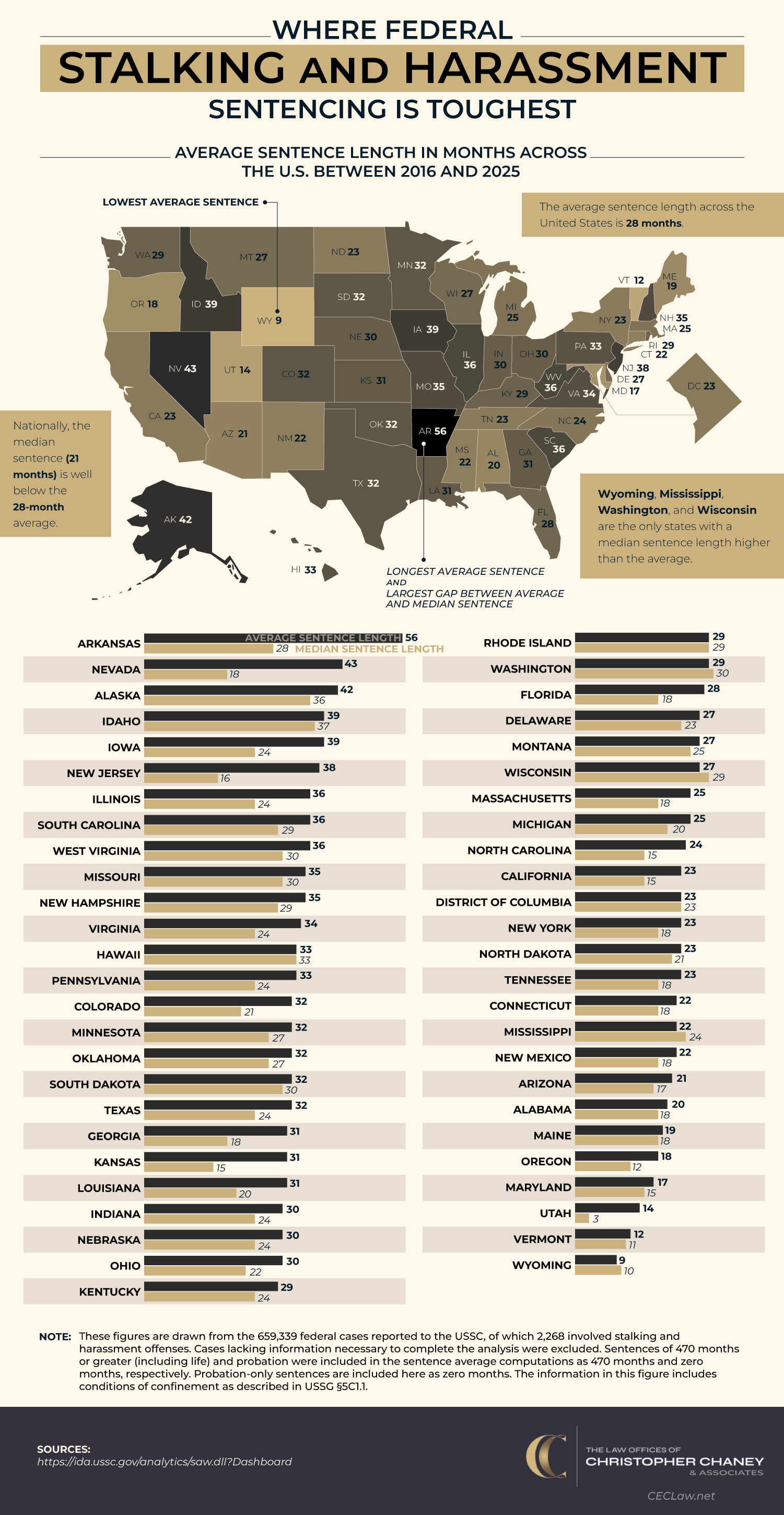
Arkansas ranks as the toughest state by far, with an average federal sentence of 56 months, more than a year longer than the next-closest state. Nevada ranks second with 43 months, while Alaska averages 42 months. Idaho and Iowa round out the top five, each averaging 39 months.
At the opposite end of the spectrum, Wyoming records an average sentence of just nine months. That represents a nearly four-year gap between Arkansas and Wyoming’s average sentences, despite every case being prosecuted under the same federal legal system.
Average sentences, however, do not provide a complete picture of the data. The USSC calculates these averages using all qualifying sentences, from probation — counted as zero months — to life sentences, which are recorded as 470 months. As a result, a relatively small number of exceptionally long prison terms can substantially inflate a state’s average sentence.
Median sentences often provide a clearer picture of a typical case because they are less affected by extreme outcomes. For example, in Arkansas, the average sentence is 56 months, while the median is just 28 months. This suggests that several lengthy, potentially life sentences have pushed the average upward. We also see this in Nevada, where the average is 43 months but the median is just 18 months. In New Jersey, the average sentence is 38 months, compared with a median of only 16 months, highlighting a significant disparity between the two figures.
By comparison, states such as Hawaii and Wyoming have nearly identical averages and medians, suggesting that sentencing outcomes there tend to be more consistent across cases.
Variation in California’s Federal Districts
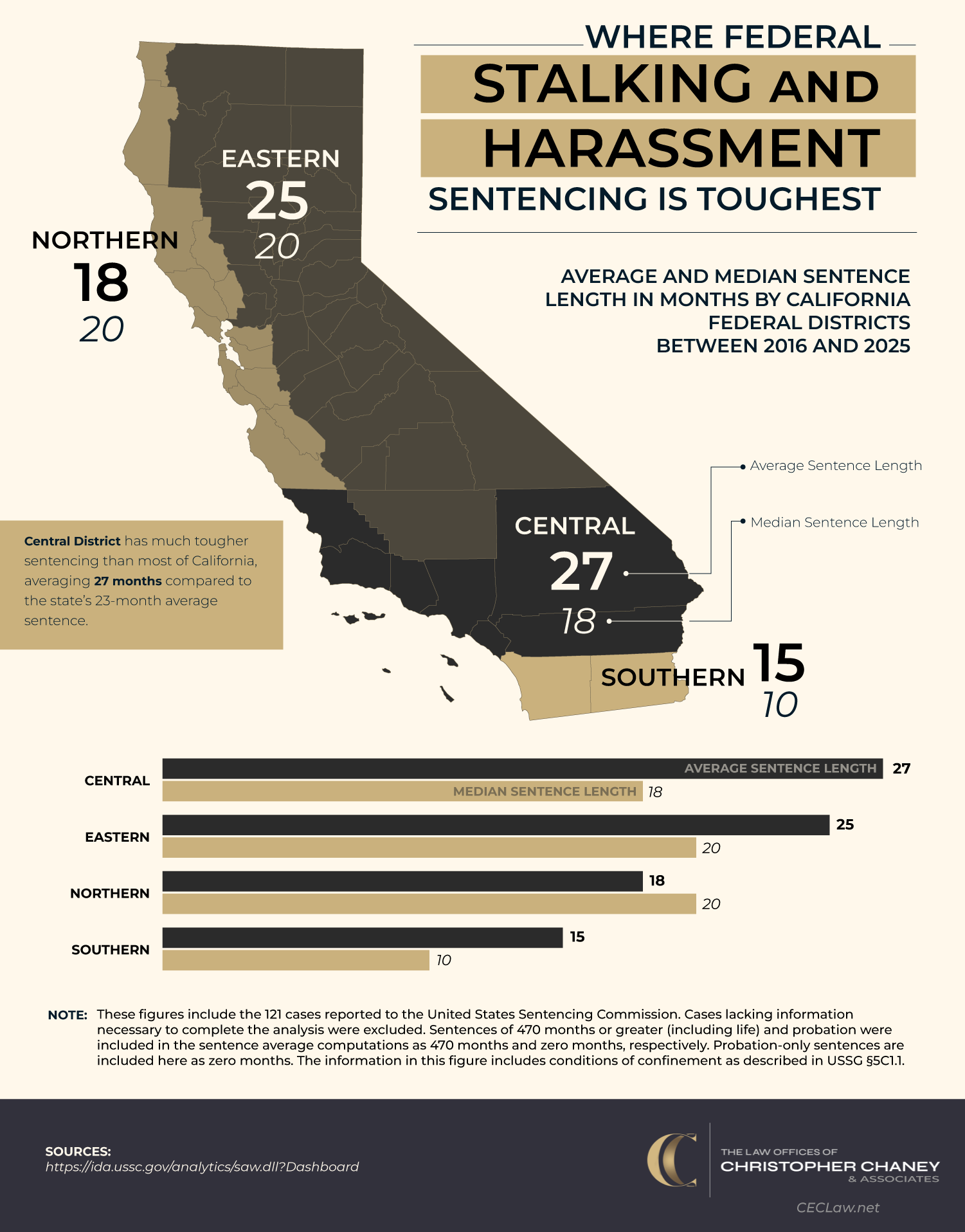
Overall, California ranks in the lower half nationally. With an average federal stalking and harassment sentence of 23 months, it sits about five months below the national average. However, the variation across California’s four federal districts demonstrates how inconsistent legal outcomes can be, even within a single state.
Embed the California infographic on your site
<a href="https://www.ceclaw.net/research-studies/where-federal-stalking-and-harassment-sentencing-is-toughest/">
  <img src="https://cdn.sanity.io/images/m2us9422/production/00a6caa7f9d11ad1a184ee1f95063c188430d9c4-1501x1916.png" alt="Where Federal Stalking and Harassment Sentencing Is Toughest in California - Chaney Criminal Defense Lawyers LA Criminal Defense Attorneys - Infographic" title="Where Federal Stalking and Harassment Sentencing Is Toughest in California - CECLaw.net - Infographic" width="1501" height="1916" style="max-width:100%;height:auto;">
</a>
<br>
<a href="https://www.ceclaw.net" title="CECLaw.net">By CECLaw.net</a>
The Central District of California, which includes Los Angeles, records the state’s highest average sentence at 27 months, followed closely by the Eastern District at 25 months. The Northern District averages 18 months, while the Southern District has the shortest average sentence at 15 months.
The difference between districts is less pronounced than we see nationally, but the data still suggest that location matters when it comes to sentence length. An offender prosecuted in the Central District has historically received an average sentence a full year longer than someone prosecuted in the Southern District.
It’s worth noting that the Northern District is the only district in the state where the median sentence (20 months) exceeds the average (18 months), suggesting there may be more probationary sentences in this region than elsewhere in the state.
For residents of Los Angeles and the surrounding communities, our findings clearly show that the Central District has historically imposed the longest average federal sentences for stalking and harassment in California, suggesting that our local courts consider this a serious offense.
If you’re facing stalking or harassment charges, you need qualified legal representation. The criminal defense attorneys at Chaney Criminal Defense Lawyers have experience handling complex federal criminal matters and understand the unique challenges these cases present. Contact us today to discuss your situation and learn how our team can protect your rights and guide you through every step of the legal process.
The Data Behind This Study
Average and Median Sentence Length in Months Across the U.S. Between 2016 and 2025
Note: These figures are drawn from the 659,339 federal cases reported to the USSC, of which 2,268 involved stalking and harassment offenses. Cases lacking information necessary to complete the analysis were excluded. Sentences of 470 months or greater (including life) and probation were included in the sentence average computations as 470 months and zero months, respectively. Probation-only sentences are included here as zero months. The information in this figure includes conditions of confinement as described in USSG §5C1.1.
Average and Median Sentence Length in Months by California Federal Districts Between 2016 and 2025
Note: These figures include the 121 cases reported to the USSC. Cases lacking information necessary to complete the analysis were excluded. Sentences of 470 months or greater (including life) and probation were included in the sentence average computations as 470 months and zero months, respectively. Probation-only sentences are included here as zero months. The information in this figure includes conditions of confinement as described in USSG §5C1.1.